Scientific Instruments and Equipments

scientifickart
SKU:
Couldn't load pickup availability

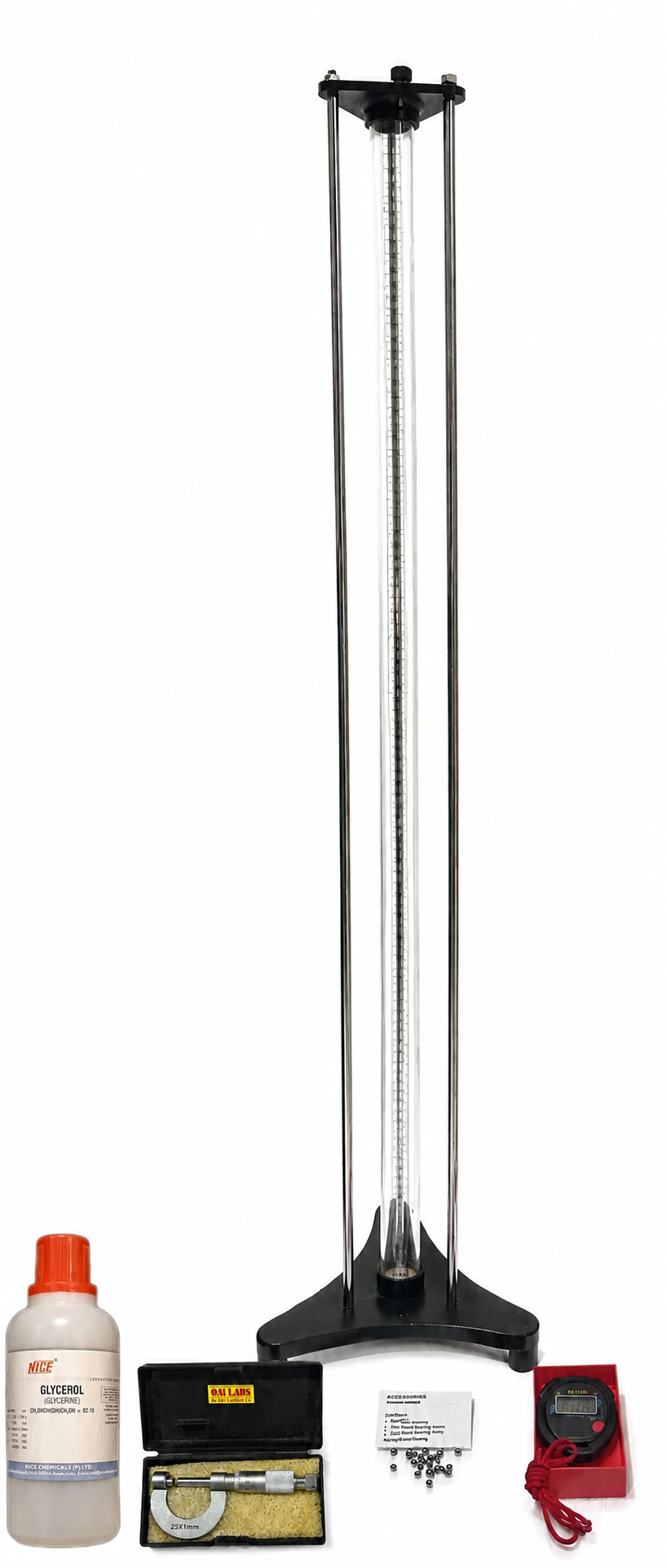
APPARATUS SUPPLIED WITH THIS EXPERIMENT
Viscosity is the property of a fluid by virtue of which an internal resistance comes into play when the liquid is in motion, and opposes the relative motion between its different layers. Thus, it is the resistance of a fluid to flow.
When liquid flows over flat surface, a backward viscous force acts tangentially to every layer. This force depends upon the area of the layer, velocity of the layer, and the distance of the layer from the surface.
Where η is the coefficient of viscosity of the liquid.
To determine the coefficient of viscosity (eta) of a viscous liquid, drop a spherical steel ball into a tall glass jar filled with the liquid. Measure the time (t) it takes to fall across a fixed distance (d) at a constant terminal velocity (Vt), and calculate viscosity using Stokes' Law formula.| Weight |
8.3 kg |
|---|---|
| Dimensions | 10 × 39 × 106 cm |